Home · Blog · Starting solids
Signs Your Baby Is Ready for Solids: The 3 Signs That Matter
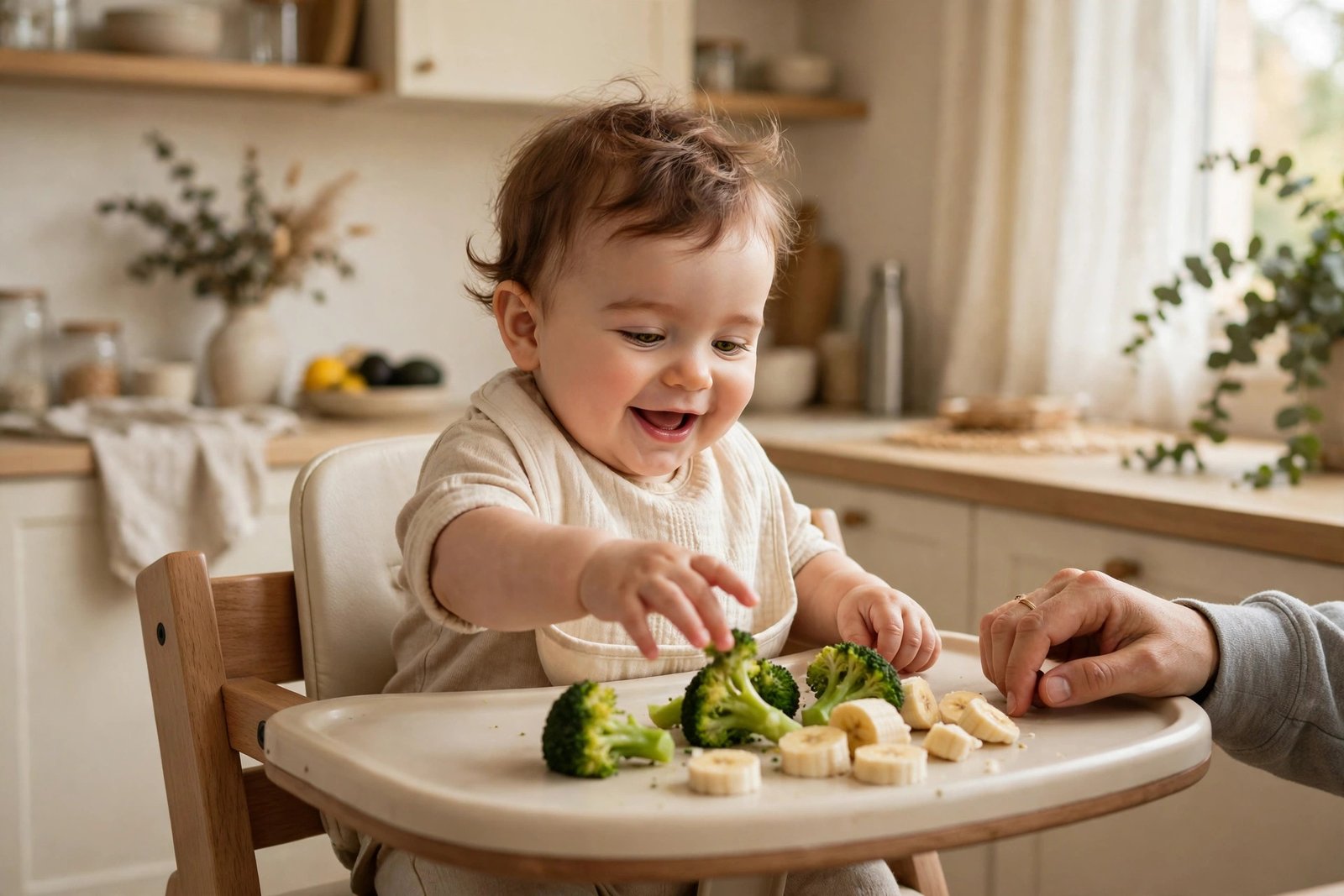
Somewhere around five months, every parent starts watching their baby watch them eat — and wondering. The good news: this is one of the least argued-about questions in baby care. The AAP, CDC, NHS and WHO all point to the same answer, and it has two parts — an age, and three signs that must show up together.
Why “around 6 months” is the consensus
It is rare for four major health bodies to agree this cleanly, but on first foods they do. Around 6 months is when most babies’ digestion, immunity and physical skills line up for food: young babies’ guts are still maturing, and the tongue-thrust reflex that pushes food back out fades right around this age. Before 4 months is too early for every baby — that line is absolute in the guidance.
The 3 readiness signs, in detail
1. Sits up and holds their head steady
Your baby can sit — in a highchair or supported on your lap — and keep their head steady and upright. This is the safety sign: a steady trunk and head are what let a baby swallow safely and turn away when they have had enough.
2. Co-ordinates eyes, hands and mouth
They watch a piece of food, reach for it, grasp it and bring it to their mouth — the full look-reach-grab-mouth chain, mostly succeeding. Clumsy is fine; coordinated is the point.
3. Swallows food instead of pushing it out
Offer a small taste on a spoon: a ready baby moves it to the back of the mouth and swallows. A baby who automatically pushes everything out with their tongue is showing you the tongue-thrust reflex — protection, not pickiness — and it means “not yet”, however keen they look.
The word that matters in all three is together. One sign alone — especially the eager staring — is not a green light.
Real signs vs not-signs
| Counts as a sign | Does not count |
|---|---|
| Sits up with a steady, upright head | Chewing fists (that is just being a baby) |
| Reaches, grasps and mouths food accurately | Waking more often at night (very common, many causes) |
| Swallows a taste instead of pushing it out | Wanting extra milk feeds (growth spurts do this) |
| Leans in and opens the mouth for the spoon | Watching you eat with fascination (curiosity starts months earlier) |
Tip: this table scrolls sideways on small screens.
The not-signs column is straight from the NHS list — they are the three “signs” most often quoted by well-meaning relatives, and none of them means a baby needs food. If naps are the thing actually falling apart at this age, our baby nap schedule by age is the more likely fix.
Record the first tastes — start free
Our free printable starter pack includes keepsake pages for the first year’s best moments. First foods deserve one of them.
Get the free starter pack →Ready or not? Run the 4-point check
Before the first spoon, work through these four — all four should be a yes:
- Age: around 6 months — and definitely not before 4 months.
- All three signs, together: steady sitting, hand-to-mouth coordination, swallowing not pushing out.
- Seating: your baby can sit safely and fairly upright in a highchair (with support is fine) for the length of a small meal.
- No special circumstances: if your baby was premature or has reflux, eczema, known allergies or a health condition, agree the timing with your pediatrician first — individual advice beats any chart, including this one.
Three yeses and one “nearly”? Wait a week and check again. Readiness is a door that opens over days, not a train that leaves without you — a week either way makes no difference to anything except your stress.
What the first two weeks actually look like
Lower the bar kindly: the first foods are practice, not meals. A teaspoon or two, once a day, of something soft — and most of it will decorate the tray, the bib and the baby. That is the curriculum. Breast milk or formula remains the main food for the entire first year; solids layer on top gradually.
Two habits worth starting from day one: introduce common allergens (well-cooked egg, smooth peanut butter thinned down) early in the process and one at a time, a few days apart, so any reaction has an obvious suspect; and write down first tastes. “First broccoli — suspicious. Second broccoli — betrayed.” is exactly the kind of line a baby book exists for.
Questions parents ask us
Can I start solids at 4 months?
No — the guidance is consistent that solids should never start before 4 months, and the recommendation for most babies is around 6 months, when the readiness signs appear. Starting early does not help babies sleep longer, whatever the family group chat says. The only exception is a timeline your own pediatrician sets for a medical reason.
My baby shows the signs at 5 months. Should I start?
Signs and age work as a pair: the three signs usually finish assembling right around 6 months, and starting a little early because one or two signs look strong is not the guidance. If all three signs are genuinely present and your baby is close to 6 months, a conversation with your pediatrician is the right next step — otherwise, waiting for 6 months costs nothing.
When do I introduce allergens like egg and peanut?
Once you start, current guidance is to introduce common allergens — egg and peanut are the headline ones — early in the weaning process rather than delaying them, one at a time with a few days between new allergens so any reaction is easy to trace. Serve them safely: egg well-cooked, peanut as a smooth butter thinned with water or milk, never whole nuts. If your baby has severe eczema or a known allergy, ask your pediatrician first.
Do milk feeds drop once solids start?
Not at first. Breast milk or formula stays your baby’s main food for the whole first year — early solids are tastes and practice measured in teaspoons. Milk feeds reduce gradually, led by your baby, as real meals build up over the second half of the year.
First tastes are keepsakes too
The first-food faces are first-year gold. The Tiny Moments Complete Kit gives them a proper home — a full printable baby book with milestone cards, a first-year calendar, a stats poster and handprint keepsakes, ready to print at home.
$9.99 one-time · print at home, keep forever
See the Complete Kit →Sources & further reading: NHS — Your baby’s first solid foods · CDC — When, what and how to introduce solid foods